By seven in the morning the folding tables were already up in sixteen parks, and by half past eight there was a queue at eleven of them. Health in the Parks is now in its ninth year, and it remains the single busiest day in the Winterfield calendar.
Twelve hundred volunteers took part. About four hundred were Winterfield staff giving up a Saturday. The rest came from neighborhood associations, two nursing schools, a church group that has run the Logan Heights site since the beginning, and roughly ninety people who signed up because they saw a flyer.
What the day is
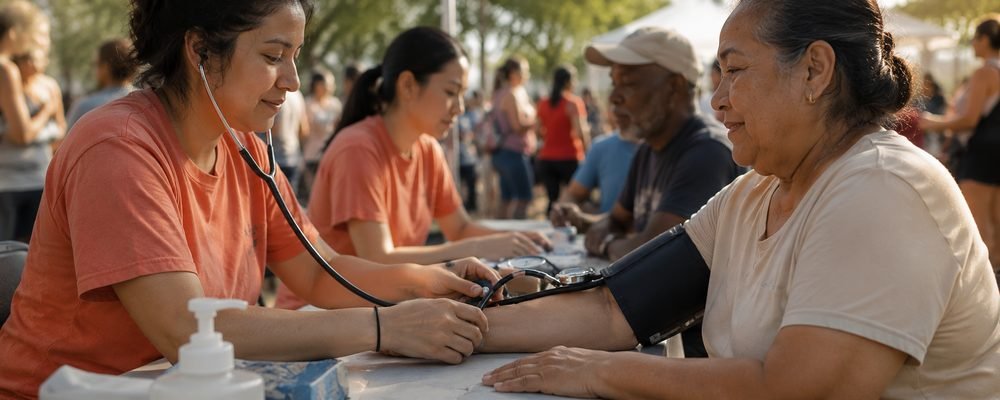
The idea has not changed since 2018. Pick a Saturday in July, put a health screening tent in a park people already go to, and remove every reason not to walk over: no appointment, no insurance check, no identification, no cost, no questions about immigration status, and someone on site who speaks the languages of the neighborhood.
Each site runs the same core set. Blood pressure. Blood glucose. Vision. Flu and COVID vaccination. A short conversation with a nurse. Anything that comes back concerning gets a follow-up appointment booked on the spot, at a clinic near that park, before the person leaves the tent.
What it found
Three hundred and sixteen people left with a follow-up appointment. Of those, 148 had a blood pressure reading high enough that we would want to see them within a fortnight, and 41 had a blood glucose result suggesting diabetes that had never been diagnosed.
That last number is the one the team talks about afterwards. Forty-one people walked into a park on a Saturday morning to get a flu shot and left knowing something about their health that they had not known an hour earlier.
Nobody comes to a park intending to find out they have diabetes. They come because their neighbor is there and there is a bouncy castle. That is exactly why it works.
Dr. Marisol Okonjo, medical director for community programsThe part that is harder than it looks
Screening is straightforward. Following up is not.
In the first two years, roughly half the people who were referred never made the appointment. Booking the appointment there and then, from the tent, with a printed card and a text message, took that figure from about 50 percent to under 20. It is now down to 14.
What made the difference was not the reminder. It was booking a clinic the person could actually get to. The team keeps a map of which park sits near which clinic and which bus routes connect them, and the volunteer doing the booking uses it. A referral to a clinic across the county is a referral that does not happen.
Health in the Parks 2026
- Sixteen sites across the county, all in public parks, all on the same Saturday.
- 1,200 volunteers, including around 400 Winterfield staff.
- Interpretation available in Spanish, Tagalog, Vietnamese, Arabic, and ASL.
- No appointment, no cost, no insurance or identification required.
- Follow-up appointments booked on site, at the nearest clinic.
Next year
Two more sites, both in the north of the county, where the nearest Winterfield clinic is a forty-minute drive and the screening numbers have historically been lowest.
Volunteer registration opens in March. Roughly two thirds of the people who volunteered this year had done it before, which is the statistic the organisers are quietly proudest of.