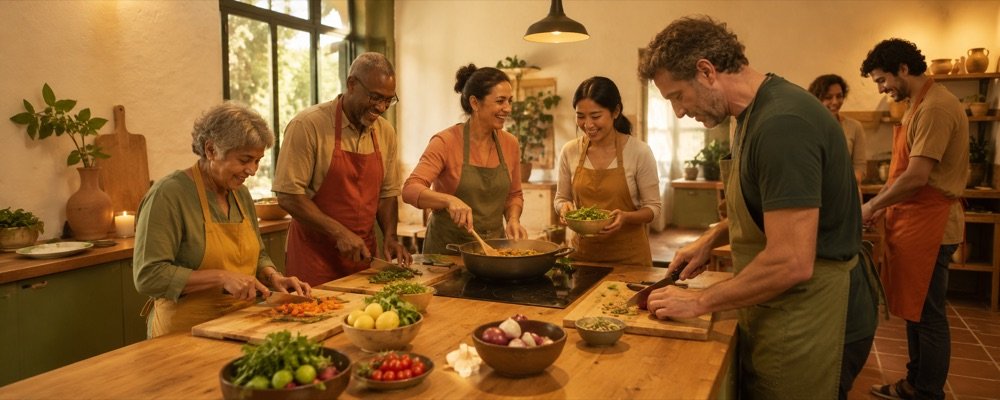
On Wednesday evenings a community room at the Mission Hills clinic becomes a kitchen. Eight people, one induction hob, a dietitian, and — on the first and last week of every course — a cardiologist who mostly does the washing up.
The course runs six weeks. Everyone in the room has been referred by a Winterfield clinician, most after a diagnosis of type 2 diabetes, hypertension, or heart failure.
What happens
They cook dinner. That is genuinely most of it.
Week one is knife skills and one recipe. Week two adds reading a label, which takes longer than anyone expects. Week three is what to do with a tin of beans. Week four the recipes are taken away and the group cooks from what is on the table. Week five is a supermarket trip with a fixed budget. Week six everyone cooks the thing they would cook for their own family and the rest of the group eats it.
I have handed out the same diet sheet for eleven years. I have never once watched somebody try to cook from it. Six weeks in that room taught me more about why it does not work than a decade of clinic did.
Dr. Owen Castellanos, cardiologyWhy it is not about food
The dietitian who runs it, Marguerite Osei, is blunt that the cooking is the vehicle rather than the point.
"Almost nobody in that room lacks information," she says. "They know salt is a problem. They have been told. What they have is a life where the honest answer at half past six on a Tuesday is whatever is quickest, and no amount of telling changes that. So we spend six weeks making the healthy option also be the quickest option, in their actual kitchen, with their actual budget."
The other half of it is the eight people. Roughly a third of each cohort keeps meeting after the course ends, without any involvement from us.
Does it work
Carefully: we do not know as much as we would like.
Completion is good, at 71 percent across two years, which for a six-week evening commitment is better than we expected. Participants report cooking at home more often, and that report holds up at six months. Average HbA1c across diabetic participants was lower at six months than at referral.
What we cannot say is that the kitchen caused it. Everyone in that room was also seeing a clinician, most had a medication change in the same period, and people who volunteer for a six-week evening course are not a random sample of anybody. A proper evaluation is planned with San Diego State for 2027. Until then this is a program we run because the room is full and people keep coming back, which is a reason but is not evidence.
Joining a course
- Six weekly sessions, Wednesday evenings, two hours each.
- Referral from a Winterfield clinician. Ask at your next appointment.
- No cost, including the ingredients, which go home with participants.
- Groups of eight. There is currently a wait of about ten weeks.
- A Saturday morning course starts in September, aimed at people who work evenings.